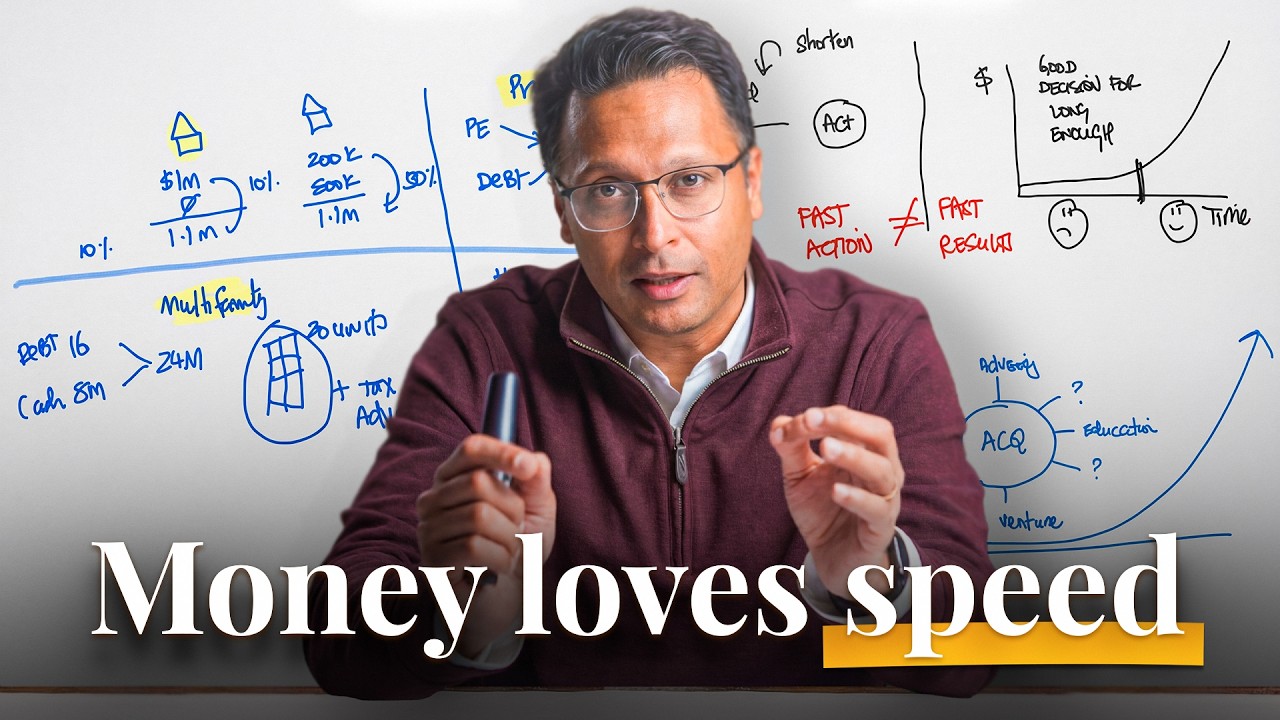
A former janitor turned billionaire breaks down the seven fundamental laws of money, explaining why most people follow the wrong rules and how wealth is actually built through momentum, structure, and asymmetry.
Law 1: Money Loves Speed, Wealth Loves Time
There is a critical distinction between making money quickly and building lasting wealth. Speed means shortening the distance between seeing an opportunity and acting on it. Time means making a good decision and holding onto it long enough to let it compound.
- Speed example: Flipping 100 homes over 5 years generates cash but no lasting wealth
- Time example: Buying and holding properties (1 unit to 4 to 20) builds a net worth five times greater in the same period
- Warren Buffett's Berkshire Hathaway compounded at nearly 20% annually from 1965 to 2024, beating the S&P 500 by double with a total return of 5 million percent
Fast action is not equal to fast results. You want to get the speed right and you want to get the time right.
Law 2: He Who Gives the Money Has the Power
In the money game, the person who provides capital controls the outcome. Buyers and builders have an unfair advantage over everyone else.
- Zero people on the Forbes 400 list got there from earned income alone
- The vast majority are buyers and builders who continuously acquire and grow companies
- Facebook bought Instagram for $1B — now worth over $45B
- Google bought YouTube for $1.6B — now the core of Google's business
- Mark Cuban bought the Dallas Mavericks for $285M, sold 73% for $3.5B
Law 3: Leverage Multiplies Everything
Leverage is the most misunderstood wealth-building tool. Used correctly, it amplifies returns and provides significant tax advantages.
Four Examples of Leverage in Action
- Real estate: Putting $200K down on a $1M home that grows 10% yields a 50% return on your cash, versus 10% if you paid all cash
- Private equity: An entire trillion-dollar industry built on using debt to acquire and grow businesses
- Commercial real estate: Bring a third in equity, finance the rest — with tax advantages and no personal guarantee
- Billionaire tax strategy: Borrow against stock (like Elon borrowing against Tesla shares to buy Twitter) to access capital without triggering taxes
Four Principles for Using Leverage
- Leverage is the number one economic growth engine
- Educate yourself on what kind of risk is available to you
- Leverage is a game of collateral — the asset backs the loan
- Leverage produces no income, therefore no taxes — a massive tax advantage
Law 4: Cash Flow Keeps You Alive, Equity Makes You Free
Cash flow funds your current lifestyle — bills, housing, daily expenses. Equity is the wealth you build for tomorrow.
- The best way to own equity is to own your own business
- The second best way is to own shares of someone else's business (publicly traded companies)
- McDonald's example: Burgers generate cash flow, but royalties ($1.6B) and real estate ($45B) create the real wealth
Law 5: Risk and Reward Are Non-Linear
The relationship between risk and reward is not proportional. Smart investors structure bets with capped downside and uncapped upside.
- A VC firm investing $100K each in five companies risks $500K maximum
- Even if three fail, one 10x and one 100x return can generate massive portfolio gains
- This portfolio theory with asymmetric risk-reward is how the best investors operate
The goal isn't to win one big time. The goal is to never lose the game.
Law 6: Don't Bet the Empire for a Pot of Gold
Sizing your bets correctly is one of the most critical investment skills. Never risk everything on a single opportunity, no matter how attractive it looks.
- A cautionary tale: A couple invested their entire $700K life savings in a single oil and gas deal that collapsed, wiping out 15+ years of savings
- Ray Dalio's approach: Keep returns the same while reducing risk — the best investors reduce risk, not chase higher returns
Two Key Takeaways
- Protect the machine that produces opportunities (your empire)
- Swing for upside only when your downside is capped
Law 7: Diversification Is a Hedge Against Ignorance
Wall Street tells you to spread money across everything, but wealthy people do the opposite — they concentrate where they have knowledge and control.
The Risk-Control Framework
- Understand risk + have control: Concentrate (e.g., your own business)
- Understand risk + no control: Still invest, but accept limited influence (e.g., Apple or Google stock)
- Don't understand risk + have control: Hire a key operator
- Don't understand risk + no control: Diversify broadly
Five Questions Before Any Investment
- Can this compound? Is it a good long-term investment?
- Who has control — you or someone else?
- What happens if it fails? Do you get some or all of your money back?
- Is the upside meaningful and larger than the downside?
- Do you understand the risks? Can you explain how the business works and what could go wrong?