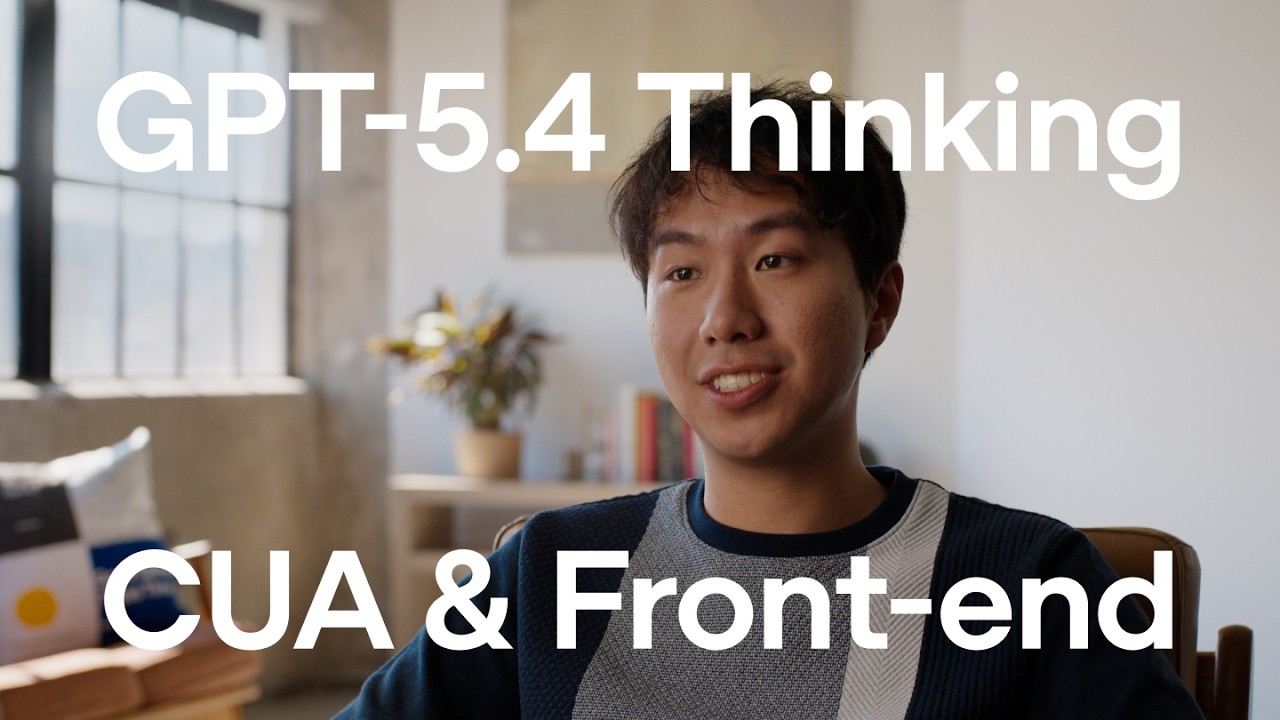
SQ from OpenAI demonstrates two major app development capabilities in GPT-5.4 Thinking: persistent computer use (KUA) that lets the model interact with computers like a human, and website replication from design images. Both showcase a key theme of models visually verifying their own work.
Persistent Computer Use (KUA)
Unlike GPT-5.3 Codex, which spins up a fresh environment for each task, GPT-5.4 maintains a persistent connection to a computer and interacts with it the way a human would—clicking, navigating, and inspecting UI elements directly.
- Dramatic efficiency gains — token usage dropped by roughly two-thirds in some testing scenarios compared to previous approaches
- Demo: 3D Chess Electron App — the model built a chess game featuring glass and marble visual effects, then used KUA to click through the game, move pieces, and verify that complex rules like castling worked correctly
- The model acts as both builder and tester, catching issues by visually inspecting the running application
Website Replication from Images
A non-coder provided a coffee shop website design as an image, and GPT-5.4 turned it into a fully functional site.
- Design context awareness — the model understood the aesthetic intent behind the design, not just the layout
- Concurrent image generation — it prompted image generation for aesthetically cohesive assets and ran multiple image-gen requests in parallel for efficiency
- Visual QA via KUA — after building the site, the model used computer use to open both the original design and the created website side-by-side to compare them
Key Takeaway
Models checking their own work like humans do—using UIs visually to verify functionality—makes work cheaper, more efficient, and produces better results.
The overarching shift is from models that only write code to models that build, run, and visually validate their output in a continuous loop, closing the gap between development and quality assurance.