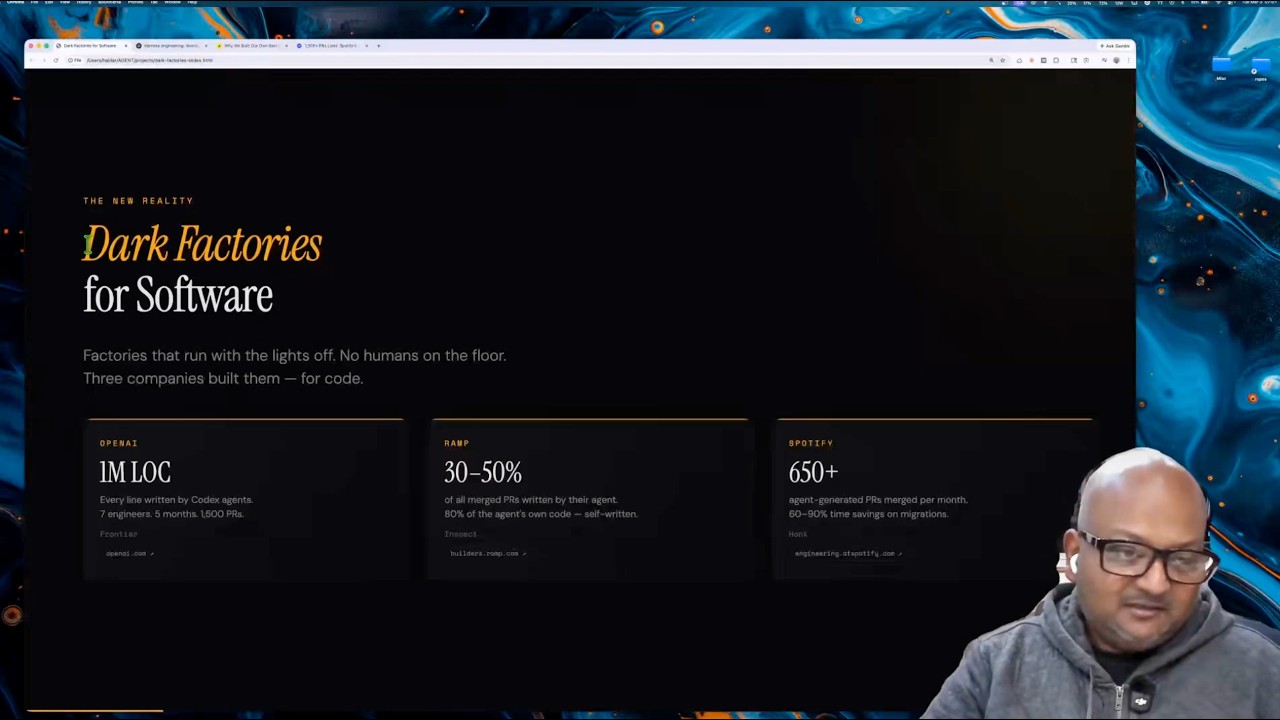
"Dark factories" is a manufacturing concept: if only robots work in a factory, you don't need the lights on. This idea is now crossing into software engineering, as demonstrated by recent reports from OpenAI, Ramp, and Spotify on shipping production code with autonomous coding agents.
Five Principles from the Front Lines
1. Harness Engineering
- Engineers shift from writing product code to engineering the environment around the coding agent
- This includes building guardrails, constraints, sandboxes, linters, and testing infrastructure
- The human role becomes designing the factory, not assembling the product
2. Verification Focus
- Paramount emphasis on detailed test suites and deterministic verifiers
- Correctness of agent-generated code is validated through automated checks, not manual review
3. Documentation as Infrastructure
- Files like agents.md, docs directories, plans, and task breakdowns become critical infrastructure
- All tacit knowledge must be externalized into files the agent can read
- If the agent can't see it, it doesn't exist
4. Constrained Agents
- More constraints and rails lead to more predictable and repeatable agent behavior
- Engineering effort is invested in building the factory itself, not the individual output
5. Externalize State
- Commit all progress, state, and knowledge to the repo
- Context is ephemeral RAM; containers are ephemeral
- Connects to Jeff Huntley's RALPH loop concept
Simplicity Wins Over Orchestration
Despite predictions of complex multi-agent orchestration, all three companies use conceptually simple approaches.
- Shared-nothing architecture with one agent per task
- Git worktrees for isolation between parallel agents
- Simple harness engineering consistently beats complex orchestration