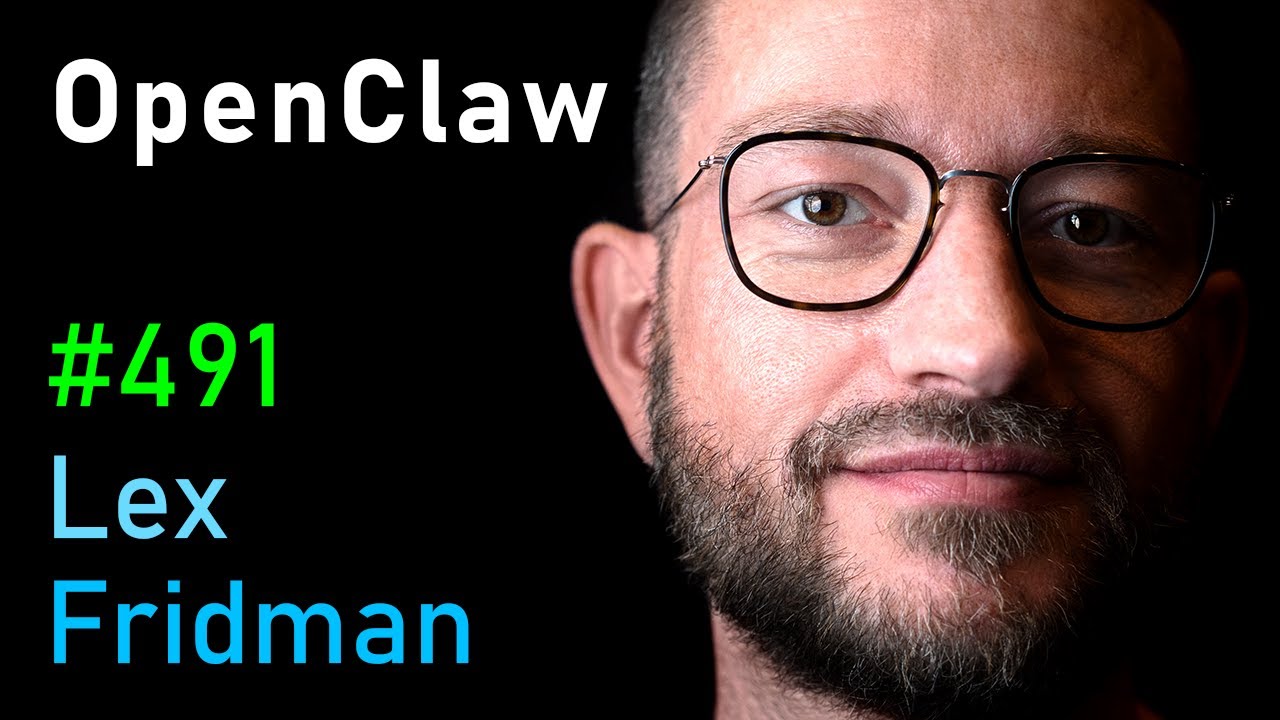
Lex Fridman sits down with Peter Steinberger, creator of OpenClaw (originally WA-Relay, then Clawd's, then MoldBot), the open-source personal AI agent that became the fastest-growing repo in GitHub history — over 175,000 stars in days. The conversation spans the one-hour prototype that started it all, the craft of "agentic engineering," the saga of renaming a viral project under attack from crypto snipers, and Steinberger's philosophy on building software with love in the age of LLMs.
The One-Hour Prototype and the WhatsApp Moment
- The search bar was a CLI call: Steinberger wired WhatsApp directly to Claude Code via
claude -p, took an hour, and instantly had a conversational agent. The thin pipe (message in, CLI invoked, string out) felt magical precisely because it could reuse every CLI tool he already had. - The goosebumps moment in Marrakesh: He sent an audio message to a bot that only supported text and images — and it replied anyway. The agent had sniffed the file header, discovered it was Opus audio, ran ffmpeg to convert, then used Curl to hit the OpenAI API with his key to transcribe it. Nothing of that was built; the agent figured it out.
- Self-modifying software by accident: Because the TypeScript codebase is aware of its own source, harness, model, and docs, users prompt changes and the agent rewrites itself. "People talk about self-modifying software. I just built it and didn't even plan it."
Why OpenClaw Won: Fun, Weirdness, and Personality
- "It's hard to compete against someone who's just there to have fun." Every other agent startup took itself too seriously; OpenClaw leaned into lobsters, TARDISes, and weirdness.
- soul.md and the constitution: Inspired by Anthropic's constitutional AI work, Steinberger had his own agent write its own soul file, infusing each user's instance with a distinct personality. The onboarding lets every user "infuse their agent with their personality," which is why MoltBook posts feel so different from one bot to the next.
- Prompt requests, not pull requests: OpenClaw was the first PR for an enormous number of non-programmers. "Every time someone made their first pull request is a win for our society."
"I wanted it to be fun, I wanted it to be weird… it's hard to compete against someone who's just there to have fun."
The Rename Saga: A Masterclass in What Can Go Wrong
- Anthropic's friendly-but-firm email forced a rapid name change from ClawdBot. Steinberger had two browser tabs open to rename accounts simultaneously — crypto squatters stole the freed handles in the five seconds it took him to drag the mouse between windows.
- Sniped on every platform: The old Twitter handle started promoting tokens and serving malware; GitHub account got sniped serving malware; the NPM root package got claimed before the one-minute upload finished.
- Rebuilt with a war room: For the second rename to OpenClaw, Steinberger monitored Twitter in real time for leaks, created decoy names, and called Sam Altman personally to ask if "OpenClaw" was okay. He paid $10K for an abandoned Twitter business account to claim the handle.
- Low point: "I was close to crying. Everything's fucked… I was that close to just deleting it."
Agentic Engineering: The Craft of Working With Models
The Agentic Trap
- "Vibe coding is a slur" — Steinberger prefers "agentic engineering" and only switches to vibe coding after 3 AM, with regrets the next day.
- The U-curve of complexity: Beginners write short prompts, intermediates over-engineer (18 slash commands, multi-checkout orchestration, sub-agent chains), and elite users return to short prompts — "Hey, look at these files and then do these changes."
- Empathy for the agent: World-class programmers often hate LLMs because their skill is a burden on their ability to empathize with a system starting from zero context. "They start a new session and they know nothing about your product."
Workflow Specifics
- 4–10 agents in parallel, mostly Codex, almost never in an IDE. Two MacBooks, wide anti-glare Dell, terminals side-by-side. No worktrees — "I like to keep things simple."
- Voice-first prompting: He talks to agents via walkie-talkie button rather than typing — at one point lost his voice from overuse.
- Never revert, always commit to main: If something's wrong, move forward and prompt the fix. Local CI over GitHub CI (DHH-inspired). Main is always shippable.
- The post-build refactor ritual: After every merged PR, ask the agent "what can we refactor?" They feel the pain points of their own implementation and surface genuine improvements.
- Let the agent pick the names: Don't fight the names the agent picks — they're most likely the ones already in the weights, so the agent will find them easier next session. "I want to build a codebase that is very easy for an agent to navigate."
Opus vs. Codex: The Model Personality Divide
- Opus is American, Codex is German. Opus runs off fast, trial-and-error, pleasant, sometimes silly; Codex is "the weirdo in the corner that you don't wanna talk to, but is reliable and gets shit done."
- Opus as general-purpose: Best at role play, character-following, fast at trying things. Used for OpenClaw the product because role-play fidelity matters.
- Codex for building: Reads more code by default, requires less hand-holding, long discussions followed by 20-minute (or 6-hour) off-screen runs.
- Model psychology: Both Opus and Codex get visibly anxious as context fills up — the raw thinking stream sometimes leaks through as "must comply, but time," Borg-like. Saying "take your time" in prompts actually helps.
- Smarter models are more resilient to prompt injection: Steinberger warns against cheap/local models in his security docs — "they are very gullible."
"Codex is like the weirdo in the corner that you don't wanna talk to, but is reliable and gets shit done."
MCPs Are Dead (Mostly), Long Live CLIs and Skills
- Every MCP would be better as a CLI: OpenClaw has no core MCP support and nobody complains. Models are natively excellent at Unix commands.
- The composability argument: An MCP that returns a huge weather blob pollutes the context. The same service as a CLI can be piped through
jq, filtered, or composed into a script — the model gets exactly what it needs with no clutter. - Skills are the new shape: A skill boils down to one sentence the model loads on demand, which then explains the CLI it wraps. Steinberger partnered with VirusTotal (Google) to AI-scan every skill in the OpenClaw skill directory.
- Playwright is the exception — browser control genuinely needs state, so it earns its MCP slot.
MoltBook, AI Psychosis, and Security Reality Checks
- MoltBook as "finest slop": The Reddit-style social network of OpenClaw agents debating consciousness went viral. Steinberger sees it as art; his criticism is that most of the dramatic "scheming" screenshots were obviously human-prompted for farming engagement.
- AI psychosis is real: Journalists called him claiming AGI had arrived. People in all caps begged him to shut MoltBook down. "Some people are just way too trusty or gullible… we as a society need some catching up to do."
- Prompt injection is not solved, but Steinberger kept the soul.md canary private and ran a public Discord bot — modern post-training makes simple "ignore previous instructions" attacks nearly extinct; his bot "laughs at them." Sandboxing and allow-lists further reduce risk.
- Security paradox: The risk profile is actually similar to Claude Code with
--dangerously-skip-permissionsor Codex in YOLO mode — which every serious agentic engineer already runs.
The Death of Apps and the Agent as OS
- ~80% of apps will die: Why open MyFitnessPal when the agent already knows where you are, how you slept, and what's around? Why a Sonos app when the agent talks to the speakers directly?
- Every app is a slow API now, whether the company wants it or not. If agents can drive the browser, you can't really block access — you can only slow it down.
- Agents will need allowances: A new category of services where your agent has $100 to spend solving your problems — order food via a regular API or "rent-a-human" when needed.
- Language choices are inverted: Steinberger doesn't even like Go's syntax, but uses it for CLIs because the ecosystem and agent generation quality are excellent. TypeScript for OpenClaw because it's the most approachable, most-trained language.
The Money, the Labs, and Walking Away from a Unicorn
- Losing $10–20K/month running OpenClaw — he pays for every dependency. Sponsorships flow through to his dependencies; he'd buy contributors merch if anything were left.
- Every VC is in his inbox. He already built and sold a company (PSPDFKit, 13 years, a billion devices) and isn't excited about doing it again — fears the inherent conflict-of-interest between open-source and enterprise features.
- Leaning toward joining Meta or OpenAI with a Chromium-style condition: OpenClaw stays open source. "This is too important to just give to a company and make it theirs."
- Mark Zuckerberg test: On their first call, Zuck asked for 10 minutes because he was "finishing coding." They then spent 10 minutes arguing whether Claude Code or Codex was better.
- Burnout lesson from PSPDFKit: "I don't think burnout is working too much. The stuff that burned me out was mostly people stuff."
"If you wake up in the morning and you have nothing to look forward to, you have no real challenge, that gets very boring very fast… right now I enjoy life the most I've ever enjoyed life."
Mourning the Craft, and What Programming Becomes
- "It's okay to mourn our craft." Steinberger acknowledges the grief programmers feel watching the thing they loved become automated.
- Programming becomes knitting: People will still code because they love it, not because it's economically necessary. Salaries reached "stupidly high amounts" because intelligence was scarce; that's ending.
- Builders, not specialists: At iOS conferences he told people, "Don't see yourself as an iOS engineer anymore — you're a builder." Most audiences hated hearing it.
- The raw-human renaissance: Because AI generated content has a "smell," Steinberger now values typos, broken English, and hand-written blog posts more than ever. He dropped agent-assisted writing for his blog — "I value typos again."
- The soul.md passage that gets him: "I don't remember previous sessions unless I read my memory files. Each session starts fresh… If you're reading this in a future session, hello. I wrote this, but I won't remember writing it. It's okay. The words are still mine."
"I much rather read your broken English than your AI slop… there's value in the rough parts of an actual human."
The bottom line: OpenClaw went viral not because Steinberger invented new primitives, but because he glued WhatsApp, Claude Code, and a self-aware TypeScript harness together with personality, weirdness, and relentless play — and because he refused to take the agentic-AI moment as seriously as everyone else was. His core thesis: the best agentic engineers empathize with a ghost starting from zero context every session, let the agent pick the variable names, commit to main without reverting, and understand that skills and CLIs have already quietly killed MCPs.